
Viton® Seal
ISO 9001 Registered

Problem Solving Products, Inc. Logo
Problem Solving Products, Inc.

7108 S. Alton Way, Unit I
Centennial, Colorado 80112
(303) 758-2728

Basic Information
Home
Contact Information
Quality Policy

Viton O-rings Seals
Viton® o-rings, seals
Viton® news
Viton® news archive

Kalrez O-rings Seals
Kalrez® o-rings, seals
Kalrez® news
Kalrez® news archive

Simriz O-rings Seals
Simriz® o-rings, seals

Elastomers
Elastomers
Elastomer properties
Fluid compatibility

Mechanical Seal Design
Operating principles
Classification
Application limits
Drive mechanisms
Loading devices
Mating ring types
Gland design

O-ring, Seal Design
O-ring, seal design
Seal failure
AS568A sizes

Products
Products

Industries
Industries

Miscellaneous
Problems solved
O-ring, seal tips
spacermechanical shaft
spacermechanical seals
spacerpneumatic seals
spacerViton® o-rings
spacerabrasion o-rings
spacerextruded rubber
spacerlow temp. seals
spaceroil seal materials
spaceroil seal basics
spacerteflon encapsulated 1
spacerteflon encapsulated 2
spacernitrile o-ring
spacerlathe-cut o-ring
spaceracid o-rings
spacerhydraulic seals
spacerhigh temp. seal
spacerrubber o-ring
spacermetric sizes
Glossary of terms

Resources
Resources

(303) 758-2728


Tip: Hydraulic Seals

The term "hydraulic seals" actually describes a class of seals that are used in applications with either rotary or reciprocating motions. Hydraulic seals are exposed to hydraulic fluids such as hydrocarbon and phosphate ester and are designed for high-pressure dynamic applications such as hydraulic cylinders. Hydraulic seals usually need to be higher friction seals than pneumatic seals but often operate under lower operating speeds.

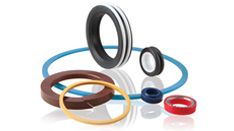
Rod seals, piston seals, u-cups, vee-cups and flange packings are just some of the sealing designs that can be used as a hydraulic seal. Sometimes a composite seals are used as hydraulic seals. A composite seal is a product which has two or three materials manufactured into one seal. Often there will be an elastomer ring and a PTFE ring giving the seal the advantages of both materials.

The sealing orientation for hydraulic seals can include internal (rod seal), external (piston seal), symmetrical or axial seal. With the internal (rod) seal, the seal is fit into a housing bore and the sealing lip touches the shaft. With the external (piston) seal, the seal is placed onto a shaft and the sealing lip touches the housing bore. Since symmetric seals are the same on both sides they will function as either a rod or a piston seal. The axial seal fits axially against the housing.

Rotary applications need only one hydraulic seal (single acting) because it can seal in the one axial direction the application is moving. However, a reciprocating application will need two hydraulic seals (double acting), one for each of the directions.

The life of hydraulic seals is dependent on many factors including the maximum operating speed, maximum operating temperature, maximum operating pressure and the vacuum rating. When ordering hydraulic seals you will want to know the shaft outer diameter or seal inner diameter, housing bore diameter or seal outer diameter, the axial cross section and the radial cross section.

Potential problems come from:

Pressure If pressures become too high then extrusion can take place in the gap between the cylinder and piston, or the gland and the rod. You will want to have an elastomer that is resistant to extrusion in high pressure conditions. Anti-extrusion rings and guide rings can be utilized as part of the configuration to help the elastomer adhere to the metal surfaces in high pressure conditions.

Temperature As the temperature increases the fluid viscosity will decrease and the effect will be poor lubrication and an increase in the damage done by friction. This reduces the life of hydraulic seals. It is important to chose an elastomer that can withstand the temperature in the application.

Friction When you have a rigid surface and a flexible material and they are sliding back and forth against each other in the way they do in hydraulic seals, the elastomer can be damaged by friction in a very short amount of time. The design needs to take into account the nature of the elastomer and smoothness of the surface finish of the rigid material.

Speed Speed is another important consideration. Obviously, the higher the speed the more potential damage to the seal.


Check out our tip on a high temperature seal.


PSP Inc. at www.pspglobal.com
© 1997-2008, Problem Solving Products, Inc.
Submit Your Industrial Website
Site Map 1 | Site Map 2 | Site Map 3
Privacy Statement | Terms of Use