|
7108
S. Alton Way, Unit I |






Basic
Information
Home
Contact Information
Quality Policy
Terms & Conditions
Kalrez O-rings
Seals
Kalrez o-rings, seals
Critical
properties
Compatibility
chart
Zalak
seals
Availability
of parts
Kalrez
industries
Chemical
process
Semiconductor
Ultrapure
TriLobe
seal
Pharma
and food
Kalrez Sanitary
seals
FDA
compliance
Oil
and gas
Kalrez
news
Kalrez
news archive
Viton O-rings Seals
Viton o-rings, seals
Simriz
O-rings Seals
Simriz o-ring,
seal
Metal
Detectable Seals
Metal
detectable
Elastomers
Elastomers
Elastomer properties
Fluid compatibility
Mechanical
Seal Design
Operating principles
Classification
Application limits
Drive mechanisms
Loading devices
Mating ring types
Gland design
O-ring, Seal Design
O-ring, seal design
O-ring,
seal failure
 Environment
Design analysis
Elastomer
General factors
Seal failure 1
Seal failure 2
Seal failure 3
Seal
failure 4
PSP o-ring sizes
Products
Products
Industries
Industries
Miscellaneous
Problems solved
O-ring, seal tips
Glossary
of terms
(303) 758-2728
Home > O-ring, Seal Failure Analysis > Part 1
O-ring and Seal Failure Part 1
Extrusion, Over-Compression and Spiral Failure
|
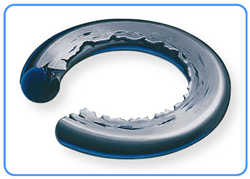
Extrusion (and/or Nibbling) Description: The o-ring or seal develops ragged edges (generally on the low-pressure side) which appear tattered. Contributing Factors: Excessive clearances. Excessive pressure. Low-modulus/hardness elastomer. Excessive gland fill. Irregular clearance gaps. Sharp gland edges. Improper sizing. Suggested Solutions: Decrease clearances. Higher-modulus/hardness elastomer. Proper gland design. Use of polymer backup rings. |
|
|
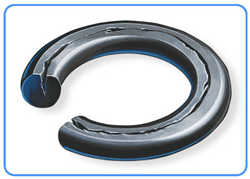
Over-Compression Description: The o-ring or seal exhibits parallel flat surfaces (corresponding to the contact areas) and may develop circumferential splits within the flattened surfaces. Contributing Factors: Improper design-failure to account for thermal or chemical volume changes, or excessive compression. Suggested Solutions: Gland design should take into account material responses to chemical and thermal environments. |
|
|
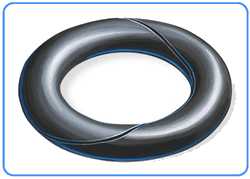
Spiral Failure Description: The o-ring or seal exhibits cuts or marks which spiral around its circumference. Contributing Factors: Difficult or tight installation (static). Slow reciprocating speed. Low-modulus/hardness elastomer. Irregular O-ring surface finish (including excessive parting line). Excessive gland width. Irregular or rough gland surface finish. Inadequate lubrication. Suggested Solutions: Correct installation procedures. Higher modulus elastomer. Internally lubed elastomers. Proper gland design. Gland surface finish of 8-16 microinch RMS. And possible use of polymer backup rings. |
|
Next Topic: Chemical Degradation, Thermal Degradation and Explosive Decompression
We are located in the Denver Technological
Center in a suburb of Denver, Colorado
©1997-2017, Problem Solving Products, Inc.
Website Map | Privacy Statement
| Terms of Use