|
7108
S. Alton Way, Unit I |






Basic
Information
Home
Contact Information
Quality Policy
Terms & Conditions
Kalrez O-rings
Seals
Kalrez o-rings, seals
Critical
properties
Compatibility
chart
Zalak
seals
Availability
of parts
Kalrez
industries
Chemical
process
Semiconductor
Ultrapure
TriLobe
seal
Pharma
and food
Kalrez Sanitary
seals
FDA
compliance
Oil
and gas
Kalrez
news
Kalrez
news archive
Viton O-rings Seals
Viton o-rings, seals
Simriz
O-rings Seals
Simriz o-ring,
seal
Metal
Detectable Seals
Metal
detectable
Elastomers
Elastomers
Elastomer properties
Fluid compatibility
Mechanical
Seal Design
Operating principles
Classification
Application limits
Drive mechanisms
Loading devices
Mating ring types
Gland design
O-ring, Seal Design
O-ring, seal design
O-ring,
seal failure
 Environment
Design analysis
Elastomer
General factors
Seal failure 1
Seal failure 2
Seal failure 3
Seal
failure 4
PSP o-ring sizes
Products
Products
Industries
Industries
Miscellaneous
Problems solved
O-ring, seal tips
Glossary
of terms
(303) 758-2728
Home > O-ring, Seal Failure Analysis > Part 2
O-ring and Seal Failure Part 2
Chemical Degradation, Thermal Degradation and Explosive Decompression
|
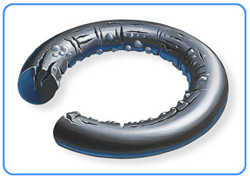
Chemical Degradation Description: The o-ring or seal may exhibit many signs of degradation including blisters, cracks, voids or discoloration. In some cases, the degradation is observable only by measurement of physical properties. Contributing Factors: Incompatibility with the chemical and/or thermal environment. Suggested Solutions: Selection of more chemically resistant elastomer. |
|
|
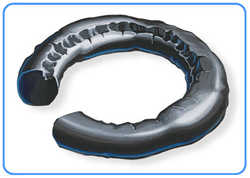
Thermal Degradation Description: The o-ring or seal may exhibit radial cracks located on the highest temperature surfaces. In addition, certain elastomers may exhibit signs of softening-a shiny surface as a result of excessive temperatures. Contributing Factors: Elastomer thermal properties. Excessive temperature excursions or cycling. Suggested Solutions: Selection of an elastomer with improved thermal stability. Evaluation of the possibility of cooling sealing surfaces. |
|
|
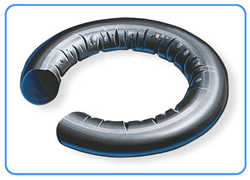
Explosive Decompression Description: The o-ring or seal exhibits blisters, pits or pocks on its surface. Absorption of gas at high pressure and the subsequent rapid decrease in pressure. The absorbed gas blisters and ruptures the elastomer surface as the pressure is rapidly removed. Contributing Factors: Rapid pressure changes. Low-modulus/ hardness elastomer. Suggested Solutions: Higher-modulus/hardness elastomer. Slower decompression (release of pressure). |
|
Next Topic Plasma Degradation, Contamination and Abrasion
We are located in the Denver Technological
Center in a suburb of Denver, Colorado
©1997-2017, Problem Solving Products, Inc.
Website Map | Privacy Statement
| Terms of Use