|
7108
S. Alton Way, Unit I |






Basic
Information
Home
Contact Information
Quality Policy
Terms & Conditions
Kalrez O-rings
Seals
Kalrez o-rings, seals
Critical
properties
Compatibility
chart
Zalak
seals
Availability
of parts
Kalrez
industries
Chemical
process
Semiconductor
Ultrapure
TriLobe
seal
Pharma
and food
Kalrez Sanitary
seals
FDA
compliance
Oil
and gas
Kalrez
news
Kalrez
news archive
Viton O-rings Seals
Viton o-rings, seals
Simriz
O-rings Seals
Simriz o-ring,
seal
Metal
Detectable Seals
Metal
detectable
Elastomers
Elastomers
Elastomer properties
Fluid compatibility
Mechanical
Seal Design
Operating principles
Classification
Application limits
Drive mechanisms
Loading devices
Mating ring types
Gland design
O-ring, Seal Design
O-ring, seal design
O-ring,
seal failure
PSP o-ring sizes
Products
Products
Industries
Industries
Miscellaneous
Problems solved
O-ring, seal tips
 mechanical
shaft
mechanical
shaft
mechanical
seals
pneumatic
seals
abrasion o-rings
extruded
rubber
low temp. seals
oil
seal materials
oil
seal basics
FEP/PFA
encapsul. 1
FEP/PFA
encapsul. 2
neoprene
o-ring
nitrile o-ring
lathe-cut o-ring
acid o-rings
hydraulic seals
high temp. seal
rubber o-ring
metric sizes
Glossary
of terms
(303) 758-2728
Home > Tips > FEP/PFA Encapsulated O-ring Part 1
|
Tip: FEP/PFA Encapsulated O-ring Part 1
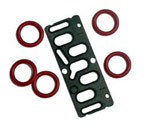
Because FEP and PFA are a hard plastic rather than a stretchy elastomer, it is uncommon to see an o-ring that is made entirely of FEP or PFA. However, there are applications where FEP and PFA are the perfect materials. For example some automotive steering systems use FEP o-rings for fittings and they are also used in paint guns. (By the way, a tip on installing these rigid seals is to heat them in hot water before the installation so they will be slightly bigger and slip on easier.) When someone says they want a FEP or PFA o-ring they may actually be talking about a FEP or PFA encapsulated o-ring. Here the FEP or PFA is made into a jacket or sleeve that will completely enclose an elastomer which has the desired mechanical properties needed for the o-ring, such as resistance to cold flow. Since FEP and PFA are practically chemically inert it allows the o-ring to resist almost all chemicals and will not allow corrosive fluids or gases to harm the elastomer. The extremely low coefficient of friction of FEP and PFA makes the encapsulated o-ring an ideal choice where surface wear might otherwise be a problem. By itself, the material FEP and PFA exhibit a useful service life from below -100° F, to temperatures of over 500° F. Their resistance to solvents remains excellent throughout a wide range of temperatures. In addition, the low dielectric constant and electrical resistance also remain intact throughout this range. Some of the advantages of these materials are:
A FEP/PFA encapsulated o-ring is often used as a static o-ring but can be used as a rotary lip seal if abrasion is handled in some way, such as mixing the FEP or PFA with graphites. FEP/PFA encapsulated o-rings are manufactured in AS568 standard sizes. However, since they are not molded in the same way as o-rings manufactured from one material, the inside diameter is not necessarily the same as a molded seal. The encapsulated o-ring will have a greater cross-sectional and inside diameter tolerance range than that of the AS568 standards. The chart below gives general information on a FEP o-ring. The properties of an encapsulated o-ring will be somewhat different than that of this plastic by itself and the properties of PFA will also be somewhat different.
* NR = Not Reported. Please Note: To the best of our knowledge, the information contained in this guide is accurate, is based upon accepted technical practices and is believed to be reliable. Final determination of suitability of any process or material is the sole responsibility of the user. PSP, Inc. does not assume any liability for the accuracy or completeness of this information. Please call us if you need help in choosing a FEP/PFA encapsulated o-ring for your application.
|
We are located in the Denver Technological
Center in a suburb of Denver, Colorado
©1997-2017, Problem Solving Products, Inc.
Website Map | Privacy Statement
| Terms of Use