|
7108
S. Alton Way, Unit I |





Basic
Information
Home
Contact Information
Quality Policy
Terms & Conditions
Kalrez O-rings
Seals
Kalrez o-rings, seals
Critical
properties
Compatibility
chart
Zalak
seals
Availability
of parts
Kalrez
industries
Chemical
process
Semiconductor
Ultrapure
TriLobe
seal
Pharma
and food
Kalrez Sanitary
seals
FDA
compliance
Oil
and gas
Kalrez
news
Kalrez
news archive
Viton O-rings Seals
Viton o-rings, seals
Simriz
O-rings Seals
Simriz o-ring,
seal
Metal
Detectable Seals
Metal
detectable
Elastomers
Elastomers
Elastomer properties
 Environment
Physics of rubber
Hardness
Tensile stress
Bulk modulus
Compression set
Stress relaxation
Shear modulus
Abrasion
Miscellaneous
High pressure
Vacuum performan.
Thermal stablility
Chemical compatibil.
Fluid compatibility
Mechanical
Seal Design
Operating principles
Classification
Application limits
Drive mechanisms
Loading devices
Mating ring types
Gland design
O-ring, Seal Design
O-ring, seal design
O-ring,
seal failure
PSP o-ring sizes
Products
Products
Industries
Industries
Miscellaneous
Problems solved
O-ring, seal tips
Glossary
of terms
(303) 758-2728
Home > Elastomer Properties > Chemical Compatibility
Chemical Seal: Chemical Compatibility
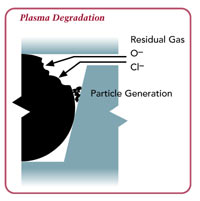
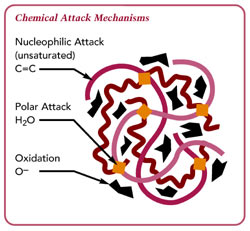
Elastomers can swell and/or degrade in chemical seal environments through reactions with the polymer backbone and cross-link system, or by reactions with the filler system. In the semiconductor industry, this degradation can be seen in increased contamination and reduced seal life.
Polymer Backbone and Cross-link:
-
Polar Attack
-
Nucleophilic Attack-main mechanism for cross-linking. However, when it occurs in chemical media, it may lead to excessive cross-linking and embrittlement.
-
Dehydrofluorination-attack resulting in the formation of unsaturated bonds on the fluorocarbon backbone. It can be caused by the attack of primary and secondary aliphatic amines.
Filler System:
-
Oxidation—degradation of carbon black fillers
-
Chemical Attack—i.e., HF acid attack of silica fillers
Special Considerations:
-
Contamination
-
Particle Generation
-
Elemental Extractables
-
Residual Gas Contamination
Special Chemical Environments:
-
Plasma Resistance
-
Vacuum—volatile condensable material
(VCM) 125°C 10-6 Torr JPL
Test Methods:
-
ISO 1817 (Liquids)
-
ASTM D471, D1460, D3137 (Liquids)
Volume Swell
The most common measure of chemical compatibility for a chemical seal is volume swell. The following formula is used in reporting volume swell measurements. This takes into account dimensional changes in all three dimensions, and is more relevant than specific dimensional change readings for a chemical seal.

Back to Properties of Elastomers
We are located in the Denver Technological
Center in a suburb of Denver, Colorado
©1997-2017, Problem Solving Products, Inc.
Website Map | Privacy Statement
| Terms of Use